Laccase for Denim Shade-Down, Indigo Cleanup, and Cleaner Finishing Routes
RivetTide supplies laccase solutions for denim laundries that need controlled shade adjustment, cleaner indigo management, and more repeatable finishing outcomes. As an enzyme supplier for denim washing, we support factories working across fashion wash, vintage wash, eco-focused finishing routes, and pumice-reduced processes.
Laccase is used where laundries need oxidative indigo modification without relying only on harsh chemical routes. In the right process window, it can help tune cast, reduce loose indigo load, support cleaner contrast, and improve batch-to-batch shade discipline.
Where Laccase Fits in a Denim Laundry
Laccase is typically evaluated when a laundry needs a controlled route for:
- Shade-down adjustment on indigo denim and selected dark wash programs
- Indigo cleanup after abrasion, cellulase treatment, or mechanical action
- Backstaining reduction support by lowering loose dye redeposition pressure
- Cleaner finishing routes with reduced dependence on aggressive oxidizers
- Pumice-reduced workflows where abrasion, contrast, and cast need tighter control
- Rewash prevention through more predictable shade movement and cleaner rinse behavior
The goal is not simply to make denim lighter. The goal is to reach the approved standard with fewer surprises: controlled shade, stable handfeel, acceptable strength retention, and fewer corrective runs.
Production Problems It Helps Address
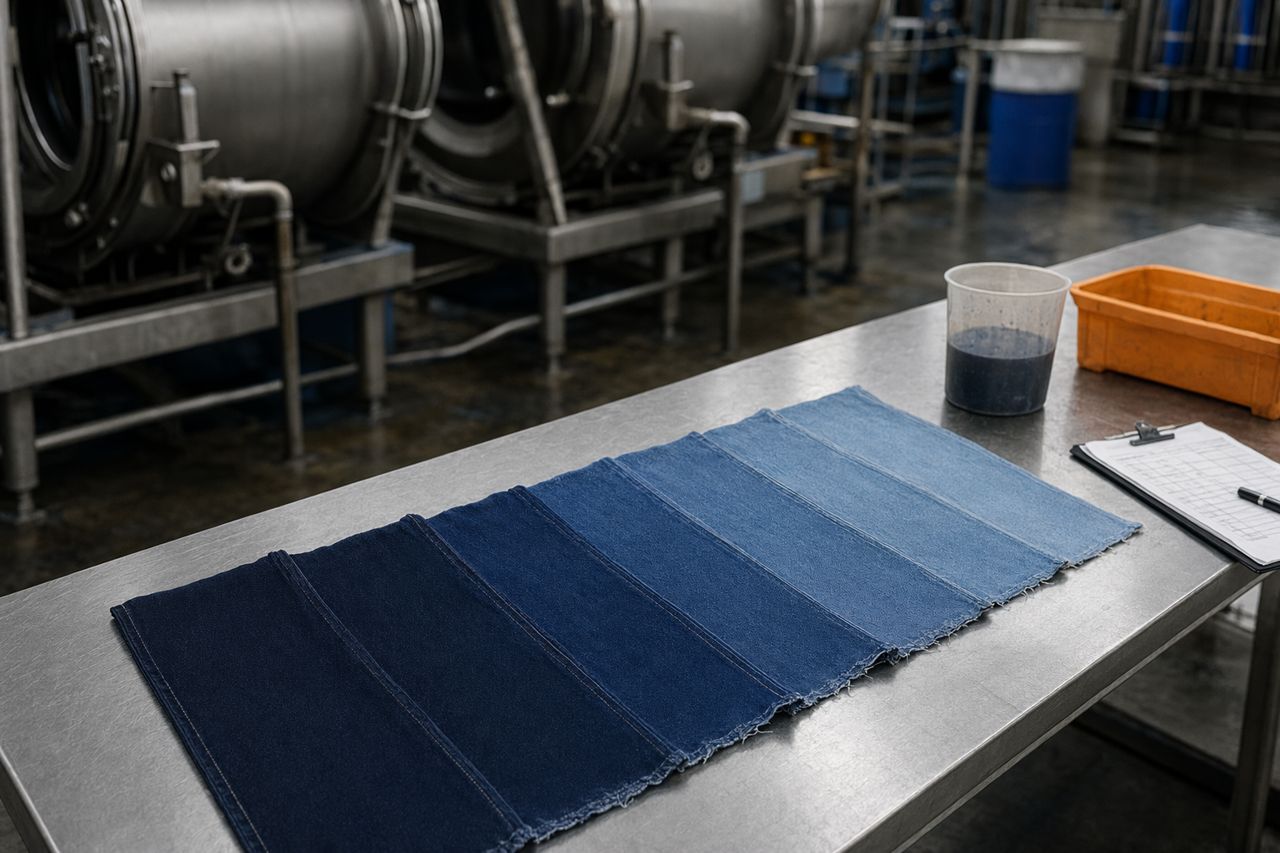
Uneven shade-down across lots
When shade movement varies by batch, the laundry loses capacity to sorting, rework, and shade correction. RivetTide laccase solutions are selected for process consistency so finishing teams can build a repeatable window around fabric type, garment load, temperature, liquor ratio, mechanical action, and cycle time.
Indigo redeposition and dull cast
Loose indigo can migrate during wash-off and rinsing, creating a flatter look or unwanted blue cast on pocketing, labels, white yarns, or high-low contrast areas. Laccase can support cleaner indigo management when used with the right wash sequence and anti-backstaining strategy.
Over-processing during chemical correction
If a laundry relies too heavily on corrective oxidation, the result can be harsh handfeel, strength loss risk, shade overshoot, or inconsistent panel appearance. Laccase gives technical teams another finishing lever for controlled shade adjustment.
Practical Benefits for Laundry Managers
- Better shade control: supports managed indigo modification instead of sudden shade jumps
- Cleaner contrast: helps protect high-low character after abrasion and wash-down steps
- Reduced backstaining pressure: assists in lowering loose indigo redeposition when the full process is tuned
- Flexible wash design: can be evaluated in short or extended programs depending on target finish
- Lower rework risk: supports first-pass approval by improving repeatability around shade and cast
- Improved route planning: fits into enzyme-led programs alongside cellulase, anti-backstaining auxiliaries, and rinse optimization
How RivetTide Supports Trials
We do not treat laccase as a one-size-fits-all additive. Denim response depends on fabric construction, indigo depth, sulfur topping, elastane content, garment load, prior abrasion, water quality, and the exact target standard.
For factory trials, RivetTide can help define:
- The best insertion point in the laundry route
- Starting dose range for pilot or production validation
- Temperature and time window based on existing equipment
- Compatibility with cellulase, detergents, dispersing agents, and neutralization steps
- Rinse strategy to reduce residual loose indigo
- Evaluation points for shade, cast, contrast, handfeel, and tensile risk
Suggested Evaluation Route
A typical evaluation can be structured around three comparisons:
| Trial leg | Purpose | What to measure |
|---|---|---|
| Current process | Establish plant baseline | Shade, cast, backstaining, handfeel, rewash rate |
| Laccase-assisted route | Test controlled indigo modification | Shade-down level, contrast retention, rinse clarity |
| Optimized route | Lock process window | Batch repeatability, cycle time, cost-in-use, approval rate |
Final production settings should be validated on the actual garment, machine type, water condition, and approved buyer standard.
Built for Denim Laundry Reality
RivetTide laccase programs are designed for laundries balancing finish quality with throughput. That means process recommendations must work around real operating constraints:
- Mixed garment weights and fabric constructions
- Variable indigo depth and sulfur topping
- Front-load, side-load, and drum washer differences
- Existing abrasion, cellulase, and neutralization steps
- Buyer limits for shade tolerance, strength, and appearance
- Production pressure to reduce rewashes and hit shipment dates
We focus on controllable parameters and practical plant-floor execution, not lab language.
Quality and Supply Expectations
For B2B buyers, consistency matters as much as enzyme selection. RivetTide supports denim laundries with batch documentation, technical guidance, and supply planning for production-scale programs. Our team can discuss packaging formats, storage expectations, lead times, and trial-to-production transition planning based on your laundry volume.
When to Request a Quote
Request a quote if your factory is:
- Developing a laccase-assisted shade-down process
- Reducing aggressive chemical correction steps
- Trying to improve indigo cleanup after abrasion or enzyme washing
- Managing backstaining complaints or dull cast issues
- Comparing enzyme suppliers for denim washing at production scale
- Building a cleaner finishing route for premium denim programs
Request a Quote
Share your garment type, target wash, current process route, machine capacity, and monthly production volume. RivetTide will respond with a practical laccase recommendation and quote for your denim laundry.